


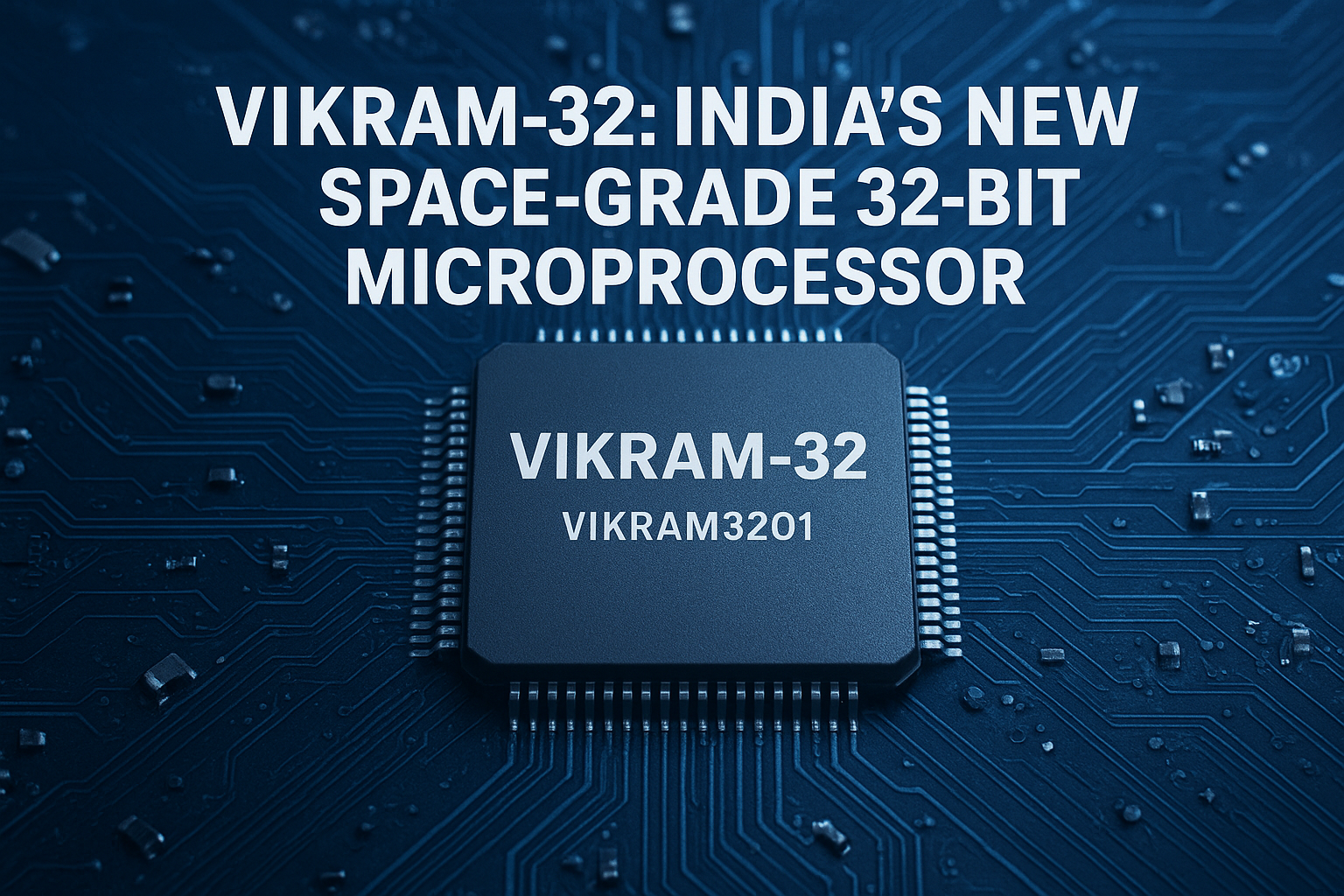
India has taken a giant leap in the semiconductor and space technology sector with the launch of Vikram-32 (VIKRAM3201), the country’s first fully indigenous 32-bit microprocessor. Developed by ISRO’s Semiconductor Laboratory (SCL) in Chandigarh and unveiled at Semicon India 2025, this chip represents a major milestone in India’s journey towards technological self-reliance.
What is Vikram-32 and why is it Important?
The Vikram-32 chip is a space-grade processor designed to power satellites, launch vehicles, and other mission-critical systems. Unlike commercial processors, space-grade chips must withstand extreme radiation, temperature fluctuations, and vibrations during launch. By developing Vikram-32 indigenously, India reduces dependence on foreign suppliers and strengthens its AatmaNirbhar Bharat (self-reliant India) vision.
Key Features of Vikram-32 Chip
Vikram-32 is packed with advanced features that make it suitable for space and defense applications:
-
32-bit architecture with support for floating-point operations
-
Radiation-hardened design, making it resistant to cosmic radiation in space
-
Fabricated on a 180nm CMOS process at SCL, Mohali
-
MIL-STD-1553B bus interface for reliable communication in aerospace systems
-
Ada programming toolchain for deterministic and safe software development
These features put Vikram-32 in the league of global space-grade processors, giving India a competitive edge in the international space industry.
Applications of Vikram-32 in Space and Beyond
Initially, Vikram-32 will be deployed in ISRO’s space missions, including satellites, launch vehicles, and onboard computers. Its robustness also makes it suitable for defense, aerospace, automotive, and energy sectors. Beyond national use, the processor can open opportunities for India to export space-grade electronics to friendly nations.
From Vikram-1601 to Vikram-3201: The Evolution
India’s first step in indigenous chip development began with Vikram-1601, a 16-bit processor launched in 2009. Vikram-32 is the next evolution, offering double the processing power, improved interfaces, and greater mission reliability. This progress reflects how India has moved from experimental designs to flight-proven processors ready for real-world space missions.
How Vikram-32 Strengthens India’s Semiconductor Mission
The launch of Vikram-32 is not just about a chip—it is a symbol of India’s semiconductor ambition. Under the India Semiconductor Mission, the government has approved multiple fabs, design units, and R&D projects. With Vikram-32, India demonstrates its ability to design, fabricate, and test advanced processors within its borders, reducing reliance on global supply chains.
What’s Next After Vikram-32?
While Vikram-32 is a milestone, it is just the beginning. India is already working on Kalpana-3201 and VEGA RISC-V processors for commercial and IoT applications. Combined with the growing semiconductor ecosystem, these projects aim to position India as a global semiconductor hub by 2030.
Conclusion
The unveiling of Vikram-32 marks a proud moment for India. More than a processor, it represents innovation, resilience, and vision. As India moves forward with its semiconductor mission, chips like Vikram-32 will power not just rockets and satellites, but also the nation’s aspiration to become a leader in advanced technology.
